A skull decal on a stock derby cover can look good from ten feet away. Park next to it, catch a glare off the clear coat, notice an edge beginning to lift, and the difference gets real fast. Custom art versus decals is not just a question of which graphic looks tougher. It is a choice between dressing up a part and turning the part itself into a statement.
For riders who refuse cookie-cutter accessories, the right answer depends on where the graphic goes, how long you expect it to last, and whether you want your bike to look customized or unmistakably yours.
Custom Art Versus Decals: The Real Difference
A decal is a separate layer applied over an existing surface. It may be vinyl, printed film, or a transfer graphic, usually cut to fit a panel, lid, fairing, tank, or engine cover. Good decals have their place. They are fast, relatively inexpensive, and easy to swap when your taste changes. Want a temporary rally graphic, a small club mark, or a stripe package? Vinyl can get the job done without committing to a permanent build direction.
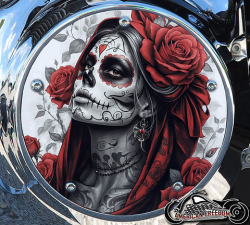
Custom art on a purpose-built motorcycle part is different. The image is applied as part of a finished component, not stuck onto the outside of a stock one. At Custom Derby Cover, high-resolution artwork is hard-coated onto precision-machined covers and accessories, creating full-coverage visual impact with a finish made for life around heat, road grime, fuel fumes, rain, and regular cleaning.
That distinction matters most on the parts riders see up close. A derby cover, timing cover, horn cover, inspection cover, fuel door, or console cover sits in the middle of the action. It catches sunlight, reflects chrome, and gets noticed at every gas stop. A thin decal can make that area look like an afterthought. Artwork built into a dedicated cover gives it weight.
Why Engine Covers Are Hard on Decals
Decals live a much easier life on a laptop than they do on a motorcycle. Even quality vinyl has enemies: heat cycles, UV exposure, vibration, washing, waxes, cleaners, rocks, moisture, and fingers brushing across the surface. On a motorcycle, those forces never really take a day off.
Engine-area parts add another problem. The surface gets hot. It is exposed to oil residue, road film, and tight spaces where a rider or wrench can nick an edge. Once a decal starts lifting, dirt works its way underneath. What began as a clean graphic can turn into a curled corner, a cloudy patch, or an outline that gives away the fact that it was applied after the fact.
That does not mean every decal fails immediately. A properly installed, high-quality decal on a protected surface can last a long time. The trade-off is that it remains a film sitting on top of the part. If you are building a show bike, ride in fair weather, and plan to change your look every season, that may be perfectly acceptable.
But if you ride hard, rack up miles, or want a graphic that still looks mean after years of heat and highway miles, a hard-coated custom cover is built for a different mission.
Full-Coverage Art Hits Different
Decals are often limited by shape. A flat graphic can look right on a flat surface, but curved covers and complex edges make installation trickier. You may have to work around bolt holes, raised areas, curves, and narrow borders. A decal that is even slightly misaligned is hard to ignore once you see it.
Custom art designed for the part takes advantage of the entire canvas. The image can run edge to edge, work around the cover’s geometry, and create a finished look from every angle. A dark angel reaper, a weathered American flag, a pinup, a military insignia, a personal photo, or your own business logo does not have to be reduced to a small sticker in the center. It can own the whole cover.
That is where photo-quality imaging earns its keep. Fine details such as feathers, flames, distressed metal, facial features, text, and shadows stay sharp. Instead of looking like a graphic applied to the bike, the accessory looks like it was made only for that graphic.
Cost Is Not Just the Price at Checkout
Decals usually win the first-round price fight. They cost less upfront, especially if you are installing them yourself. For a rider experimenting with colors or building a temporary theme, that lower entry cost is a real advantage.
The better question is what you get for the money over time. A decal may need careful prep, patient installation, replacement after damage, or removal when it starts looking tired. Removal can leave adhesive residue, and aggressive cleanup can affect the surface underneath. If you have replaced the same graphic twice, the cheap option is not always cheap anymore.
A made-to-order custom cover costs more because it is an actual motorcycle component, machined for a defined application and finished with permanent visual intent. You are paying for fitment, material, production, full-coverage art, and durability together. It is not a sticker budget. It is a custom-parts budget.
There is also resale to consider. A worn decal rarely adds value to a motorcycle. A clean, well-executed custom accessory can make the entire build look more intentional. Personal art is personal, so it will not appeal to every future buyer, but strong craftsmanship never hurts the impression your bike makes.
Fitment Is Where a Custom Part Earns Respect
A killer image means nothing if the cover does not fit. Harley-Davidson riders know that engine platforms are not interchangeable just because the parts look close in a photo. Big Twin, Twin Cam, Milwaukee-Eight, and 883/1200 Sportster applications each demand the right part profile, bolt pattern, and sizing. The same is true for Indian, Victory, and Suzuki models.
A decal avoids some fitment concerns because it goes on the part you already own. That is convenient, but it also means you are still working with whatever stock cover is on the bike. If the factory piece is scratched, oxidized, plain, or simply not worthy of the rest of your build, covering it up is not the same as replacing it.
With a custom cover, start with your year, make, model, and engine platform. Confirm the part type before you choose the artwork. A precise fit is what lets a bold graphic look professional instead of improvised. On a motorcycle, details are everything. A cover that seats correctly and follows the lines of the engine tells people you did not cut corners.
When Decals Are the Better Call
There is no shame in using decals when they match the job. They make sense for short-term event graphics, racing numbers, helmet accents, saddlebag labels, simple lettering, and projects where you want to test a design before committing. They also work for riders whose style changes constantly.
Use decals when flexibility matters more than permanence. Use custom art when the part is a focal point, the graphic carries personal meaning, and you want a finish that can take real riding. A memorial image of a family member, a unit emblem, a company logo, a patriotic design, or artwork you created yourself deserves more than a corner that may peel next summer.
Make the Graphic Worthy of the Ride
The strongest builds do not throw graphics at every surface. They choose a few visual anchors and let them hit hard. A custom derby cover can tie into your tank art, paint color, seat stitching, wheels, or exhaust finish without making the bike look overworked. If your ride is blacked out, a high-contrast cover can become the punch. If it is already loaded with chrome, darker artwork can give it some attitude.
Choose an image you will still be proud to see every time you roll into the garage. Then put it on a part built to carry it. Your bike has enough factory pieces already. Give it one that tells your story before you ever twist the throttle.