A stock motorcycle may run just fine, but it does not say much about the rider in the saddle. Motorcycle graphics change that fast. A hard-hitting image on the right component can turn an otherwise ordinary Harley, Indian, Victory, or Suzuki into a bike that carries your flag, your sense of humor, your military pride, your club identity, or your own brand of outlaw attitude.
The best part is that personalization does not have to mean rebuilding the entire motorcycle. You can set your ride off with a graphic derby cover, timing cover, horn cover, fuel door, inspection cover, or console cover. These are high-visibility details riders notice when they walk up to the bike, lean it into a turn, or pull alongside you at a light.
Motorcycle Graphics Are More Than Decoration
Paint, chrome, wheels, exhaust, and handlebars all shape a motorcycle's personality. Graphics bring a different kind of impact because they tell a story. A We The People flag graphic makes a statement before the engine fires. A skull, reaper, dark angel, pinup, eagle, or gunfighter design can give a clean black bike a completely different edge.
For some riders, the strongest graphic is not found in a catalog. It is a family photo, a unit insignia, a business logo, a memorial image, original artwork, or a design created for the rider alone. That is where custom parts earn their place. A motorcycle is personal equipment. There is no reason its details should look like everybody else's dealership accessories.
The trade-off is simple: bold art gets attention. If you want a low-profile build that disappears in a parking lot, a full-color graphic might not fit the plan. But if you built your bike to make people look twice, graphic accessories deliver a serious visual payoff without requiring a full custom paint job.
Choose Graphics That Fit the Bike's Character
The right image depends on the motorcycle and the direction of the build. A stripped-down Sportster with blacked-out controls can carry aggressive skull art, a weathered American flag, or a gritty mechanical design without feeling overdone. A polished Big Twin with lots of chrome may call for detailed patriotic imagery, classic pinup art, flames, or a design that ties into the paint color.
Think about what is already on the bike. Matte black finishes usually give bright graphics more punch. Deep red, blue, or custom paint can work best with artwork that repeats one or two colors already present. Chrome-heavy motorcycles have plenty of shine, so a graphic cover can add depth and contrast rather than another reflective surface.
Do not try to force every theme onto every part. A motorcycle with five unrelated images can look more like a sticker aisle than a finished build. Pick one central idea, then let the graphics support it. For example, a military-themed bike might carry a service emblem on the derby cover and a flag-inspired graphic on a fuel door. A Day of the Dead build can use matching sugar-skull details across engine and body accessories without losing its focus.
Start With the Parts People Actually See
You do not need to replace every cover to create a custom look. Start with the piece that has the biggest visual return for your motorcycle.
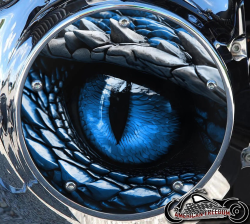
On many Harley-Davidson models, the derby cover is a natural first move. It sits in a high-traffic visual area and gives artwork a clean, round canvas. Timing covers and inspection covers can reinforce the same theme on the other side of the engine or add a smaller hit of color where a plain metal part used to be.
Horn covers are another strong choice, especially on bikes with exposed front-end styling. They sit out in the open, making them ideal for a logo, badge, skull, flag, or high-contrast artwork. Fuel doors and console covers bring graphics above the tank line, where the rider sees them every time they climb on.
The smart move is to build outward. Choose one centerpiece part first. Live with it, see how it works with the bike in real light, then add matching pieces if the bike calls for more. That approach keeps the build intentional and gives every part room to hit hard.
Durability Matters as Much as the Image
A motorcycle part does not live an easy life. It gets baked by summer heat, hit with rain, blasted by road grit, exposed to fuel vapors, and wiped down after long rides. A graphic that looks great when it comes out of the box means nothing if it fades, lifts, or turns cloudy after a season.
That is why the process behind motorcycle graphics matters. The artwork should be applied to a properly machined part and protected with a finish designed for heat and regular road use. High-resolution, full-coverage imaging gives the art its detail. A hard-coat finish helps preserve the color and edge that made you choose the design in the first place.
Be realistic about care. Even durable custom parts deserve sensible maintenance. Use products intended for motorcycle finishes, avoid abrasive pads, and wipe off fuel spills instead of letting them sit. If you are working around the engine, take the same care you would with any finished component. Strong construction does not mean a rider has to be careless.
Fitment Is Not the Boring Part
Graphic selection gets the adrenaline moving, but fitment is where you protect the investment. A killer design on the wrong cover is still the wrong cover. Harley-Davidson platforms have important differences across Big Twin, Twin Cam, Milwaukee-Eight, and 883/1200 Sportster applications. Indian, Victory, and Suzuki motorcycles have their own part shapes, mounting patterns, and clearance requirements.
Before ordering, identify the exact year, model, and engine platform. Do not rely only on what a previous owner told you. Check the motorcycle's paperwork, VIN information, owner's materials, and existing component shape. If the bike has been heavily customized, confirm that an aftermarket primary, horn assembly, or console has not changed the fitment requirements.
This is especially important when you are building a one-off part around a personal image. Made-to-order work is designed around your selected part, finish, and artwork. Taking a few extra minutes to verify compatibility is better than finding out later that you ordered for a Twin Cam when your bike runs a Milwaukee-Eight.
Make Custom Artwork Worth the Space
Personal photos and logos can make unforgettable motorcycle graphics, but not every image starts out ready for production. A crisp, high-resolution original will usually reproduce better than a tiny social media screenshot. Dark photos can lose detail in shadows, while an image packed with small text may become difficult to read on a compact round cover.
Choose one clear focal point. If it is a family photo, decide whose face or which moment matters most. If it is a company logo, use the cleanest available version with strong contrast. If it is a memorial design, consider whether a name, date, service emblem, or meaningful symbol should carry the message without crowding the artwork.
Custom Derby Cover gives riders a way to put their own photos, logos, and artwork onto functional made-to-order motorcycle parts, not just hang a graphic on the garage wall. That matters because the part becomes part of the machine's story every time you ride.
Build a Bike You Recognize From Across the Lot
The strongest custom motorcycles do not chase whatever everybody else is buying this season. They look like their owner made the calls. Maybe that means an unapologetic skull on a blacked-out Street Glide. Maybe it means a patriotic flag cover on a road-worn Heritage. Maybe it means your own logo on the bike you built after years of saying you would.
Choose artwork with a point of view, match it to the right properly fitting part, and demand a finish that can take the road. When you walk back across the lot and spot your bike before anybody else's, you will know the graphics did their job.