That skull graphic, old glory flag, unit logo, or family photo only looks badass if it lands on a part that actually belongs on your bike. Softail cover compatibility is not a matter of picking the coolest art and hoping for the best. Your Harley’s year, engine family, primary setup, and the specific cover you want to replace all decide whether that custom piece bolts on clean or turns into an expensive garage-wall decoration.
A custom cover should set your ride off, not create a fitment headache. Here is how to identify the right cover before you put your name, your colors, or the image that means something to you on it.
Softail Cover Compatibility Starts With the Part
The word “cover” gets thrown around a lot in motorcycle custom work, but it can mean several very different components. A derby cover, timing cover, inspection cover, horn cover, console cover, and fuel door may all carry the same artwork, yet none of them use the same mounting pattern.
A derby cover mounts to the outer primary cover and gives access to the clutch assembly. A timing cover mounts on the cam chest side of the engine. An inspection cover is a smaller primary component with its own shape and screw layout. Horn covers, console inserts, and fuel doors are separate pieces again. Ordering a cover based only on a graphic theme or the word “Softail” leaves too much room for error.
Start by naming the exact part you are replacing. Then identify the motorcycle it came from. That simple order prevents a lot of wrong-fit purchases.
Know Your Softail’s Engine Generation
“Softail” describes a Harley-Davidson chassis family, not one single engine or one universal cover pattern. A 2005 Softail, a 2016 Softail, and a 2023 Softail can all wear the Softail name while using different engine platforms and different cover requirements.
Older Softails commonly use the Twin Cam platform, while the current-generation Softail lineup introduced in 2018 uses Milwaukee-Eight engines. Those engine families differ in cover shape, fastener locations, and surrounding components. A timing cover made for a Twin Cam application is not automatically right for a Milwaukee-Eight Softail just because both bikes are Big Twins.
That distinction matters most when you are shopping for decorative engine covers. The artwork may be the same, but the machined base must match the engine underneath it. Precision machining is what creates a clean bolt-up, proper seating, and the finished look your bike deserves.
Why the Model Name Is Not Enough
Saying “I have a Fat Boy” gets you closer, but it still may not be enough for accurate fitment. Harley-Davidson has used model names across multiple production years, engine generations, and trim configurations. A Fat Boy 114 and an earlier Twin Cam Fat Boy do not share every cover application.
The strongest fitment details are your model year, full model name, and engine family. If you are unsure, your VIN, owner’s manual, factory parts information, or the markings on the existing cover can help verify what you have. Take a clear photo of the installed part as well. It can reveal the shape, number of mounting screws, and whether the surrounding housing matches the cover style you are considering.
Check the Bolt Pattern, Shape, and Clearance
Bolt count is useful, but it is not the whole story. Two covers can have the same number of screws and still be different in diameter, contour, screw spacing, or center profile. Never assume that a five-hole cover is a universal five-hole cover.
Look at the factory cover from straight on. Count the mounting holes, note their positions, and compare the overall outline. Is it round, pointed, oval, or shaped around another component? Check whether the cover sits flat against the housing or has a raised center section. These details matter when a cover is machined for a specific application.
Clearance is equally real. Some Softail builds carry forward controls, crash bars, exhaust systems, floorboards, custom primary components, or other aftermarket hardware that crowds the area around a cover. A replacement cover may fit the engine correctly but become difficult to access if another modification is in the way.
If you have heavily modified your bike, do not treat factory fitment as a guaranteed answer. Factory dimensions are the baseline. Your build is the final reality.
Factory Parts Versus Aftermarket Changes
Most cover fitment questions are straightforward on a stock Softail. Things get more interesting when previous owners, shops, or your own garage time have changed the motorcycle.
Aftermarket primary covers can alter derby and inspection cover fitment. Cam chest modifications can affect what belongs on the timing side. A custom horn relocation kit may change the mounting arrangement for a horn cover. Even a cosmetic piece that looks stock at first glance may have been swapped somewhere in the bike’s history.
Before ordering, inspect the part currently mounted on the motorcycle rather than relying only on the title, registration, or what you were told when you bought the bike. This is especially smart with used Harleys. A clean-looking custom build can hide years of parts changes.
There is also a difference between a decorative overlay and a replacement cover. Some products attach over an existing part. Others replace the original component entirely. A handcrafted replacement cover needs the correct fitment for the housing beneath it. An overlay must match the surface it is designed to cover. Know which style you are buying before you pull out the tools.
How to Confirm Softail Cover Compatibility Before Ordering
Do the homework before you choose the artwork. You only need a few solid details, but they need to be accurate:
- Motorcycle year, model, and engine family
- Exact cover type: derby, timing, inspection, horn, console, or fuel door
- Existing cover shape and mounting-hole layout
- Whether the related housing is factory equipment or aftermarket
- Photos of the current part if anything looks unusual
That information gives you a much better foundation than a guess based on a product image. It also protects the custom process. Made-to-order parts are built around your selection, so a correct fitment choice keeps the focus where it belongs: on the art that makes your motorcycle yours.
If a listing calls out a specific engine family, production range, or model group, read it like it matters, because it does. Those fitment notes are not fine-print filler. They are the line between a cover that drops into place and one that does not.
Choose Artwork After You Lock Down Fitment
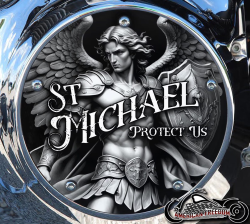
There is no reason a functional engine cover has to look factory plain. Once you have the right base part, the options open up. Go with a hard-edged reaper, a We The People flag, a military tribute, a pinup, a dark custom graphic, or a photo and logo that no other rider can claim.
At Custom Derby Cover, the visual work is built onto precision-machined parts with a high-heat hard-coat imaging process. That means the image is not an afterthought slapped on top of generic chrome. It is a full-coverage, photo-quality finish made to hold its color and attitude through the miles.
Still, cool art does not cancel out mechanical facts. Choose the application first, then choose the finish and design. If you are commissioning one-off artwork, verify the part details before production begins. A personal image deserves to live on the right canvas.
Installation Is Simple Only When Fitment Is Right
Once you have the correct replacement cover, installation is generally a clean job with the right tools and care. Protect the finish while you work, use the correct fasteners, and follow the service guidance for your specific motorcycle. Do not overtighten screws just because the cover is custom. Threads, housings, and gaskets do not care how mean the graphic looks.
For covers that seal an opening, inspect the gasket or O-ring condition before reassembly. Reusing damaged sealing material can turn a quick customization job into a leak. For non-sealing decorative pieces, make sure the part sits flush and that wiring, cables, or nearby accessories are not pinched or rubbing.
When something does not line up naturally, stop. Do not force screws into holes, enlarge mounting points, or “make it work” with improvised hardware. A properly matched cover should mount the way it was made to mount.
Your Softail already has a story in every mile, scar, and upgrade. Get the fitment right first, then put a cover on it that makes the story impossible to miss.