That bare factory circle on the side of your motor does not have to stay anonymous. A Harley Davidson timing cover is a small part with a front-row seat, sitting where riders, passengers, and anyone parked beside you can see it. Get the fitment right, choose artwork with some teeth, and that small cover can set the whole ride off without changing the bike’s attitude or reliability.
For riders building a machine that looks like theirs and nobody else’s, the timing cover is one of the smartest places to start. It is visible, affordable compared with major engine work, and easy to coordinate with a derby cover, horn cover, fuel door, or console. The trick is knowing what it covers, what fits your engine, and what separates a lasting finish from a graphic that quits after a few hot seasons.
What a Harley Davidson Timing Cover Actually Does
A timing cover is more than a decorative badge. Depending on the Harley platform, it covers a portion of the timing or cam area and provides a finished, protective cap over engine components. It helps keep the area sealed and protected while giving the engine a clean, completed appearance.
On many Harley models, the timing cover is the smaller round cover on the right side of the engine. That makes it easy to confuse with other round accessories, especially if you are shopping from photos. A derby cover generally sits on the primary side and is larger. An inspection cover also belongs to the primary assembly and has a different shape and bolt pattern. These parts may share a visual theme, but they are not interchangeable.
That distinction matters. Ordering a killer skull graphic in the wrong cover style is still ordering the wrong part. Before choosing art, confirm the year, model, engine family, cover location, diameter, bolt-hole layout, and whether your bike has any factory or aftermarket components that affect clearance.
Harley Davidson Timing Cover Fitment Comes First
Harley fitment is not a one-size-fits-all game. A cover that fits a Twin Cam may not fit a Milwaukee-Eight, and a Sportster setup follows its own rules. Even within the same broad engine family, model year and application can change the hardware, dimensions, or profile.
Start with your motorcycle’s exact information, not just the name on the tank. “Harley” is not enough. Know whether you are riding a Big Twin, Twin Cam, Milwaukee-Eight, 883 Sportster, or 1200 Sportster, along with the year and model. If you have swapped parts, installed an aftermarket cam chest, or changed engine covers during a build, inspect what is actually on the bike before ordering.
A few details deserve a close look:
- Count the mounting holes and compare their position to the cover you are replacing.
- Measure the cover diameter if the application calls for a specific size.
- Check whether the cover sits flat, has a raised profile, or needs clearance around nearby components.
- Confirm whether screws, seals, or gaskets are included with the part you are considering, or whether you will reuse existing hardware.
Do not force a cover into place because the artwork is perfect. A timing cover should seat correctly without fighting the bolts. Cross-threaded hardware, a pinched seal, or an overtightened fastener can turn a simple visual upgrade into a preventable repair. If there is any question about fitment or torque specifications, use your service manual or have a qualified motorcycle technician handle installation.
Stock Replacement or a Visual Statement?
A plain replacement timing cover makes sense when restoring a bike to factory appearance. But most riders looking at custom parts are not chasing showroom sameness. They want the motor to carry the same attitude as the paint, pipes, bars, and stance.
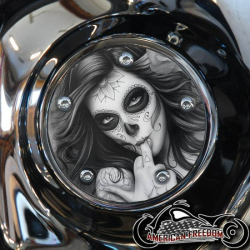
This is where a full-coverage custom cover earns its keep. Instead of a small engraved logo in the center, the entire face becomes real estate for high-resolution artwork. A distressed American flag, We The People design, Day of the Dead artwork, a Dark Angel Reaper, a unit logo, a personal photograph, or your own original graphic can turn a functional engine component into a signature piece.
There is a trade-off. Highly detailed art demands a clean, high-quality source image. A fuzzy social-media screenshot may look acceptable on a phone but lose definition when printed on a precision-machined cover. For custom artwork, start with the best original file available. Sharp contrast, strong color separation, and a design that reads at a small circular scale usually produce the hardest-hitting result.
The Finish Has to Survive the Ride
A timing cover lives near heat, road grime, rain, wash water, boot scuffs, and the occasional careless wrench. That is why the manufacturing process matters as much as the graphic itself. A design that looks wild on day one is worthless if it fades, peels, or clouds when the bike gets ridden like it should.
Look for a precision-machined part paired with a finish built for motorcycle use. Custom Derby Cover uses a high-heat hard-coat imaging process that applies full-coverage, photo-quality artwork to the part, rather than treating the design like a throwaway sticker. The goal is simple: give riders the image their heart desires while building it to hold its color and edge for the life of the motorcycle.
That durability does not mean abuse has no consequences. Brake cleaner, aggressive solvents, harsh abrasives, and metal tools can damage nearly any finished surface. Clean the cover with mild soap, water, and a soft cloth. Avoid scraping at stuck road debris. When working around the engine, cover the part or keep tools from dragging across the face.
A glossy finish tends to make colors pop and gives photographic art depth. A more subdued finish can suit blackout builds, old-school choppers, and darker graphics. Neither choice is automatically better. It depends on whether your bike is built to throw light in the parking lot or carry a meaner, lower-key look until somebody gets close.
Build a Matched Engine-Side Look
The best custom timing cover does not need to match every part on the bike exactly. In fact, copying the same artwork everywhere can make a build feel heavy-handed. A stronger move is to choose one main graphic and let the surrounding pieces support it.
If your timing cover carries a bold eagle or flag, a derby cover can use a related color field, secondary emblem, or clean black background. If you run a reaper, skull, or outlaw theme, echo one detail such as red eyes, weathered silver, or a cracked texture rather than repeating the entire image. That creates a machine with a point of view instead of a catalog page bolted together.
Think about the bike from ten feet away. Chrome, polished aluminum, blacked-out cases, and painted surfaces all affect how a cover reads. Bright artwork can become the focal point on a dark engine. On a heavily chromed bike, a darker design may provide the contrast that keeps the motor from looking busy. A cover should command attention because it belongs there, not because it is fighting every other part for it.
Personal Art Beats Cookie-Cutter Parts
Ready-made graphics are a fast way to get a finished look, especially when the design already fits your build. But custom work gives you a chance to put something on the bike that nobody at the next bike night can buy off the shelf. A family photo, a memorial image, club art, a business logo, military insignia, hand-drawn design, or personal motto can be made into a functional piece of the motorcycle.
Be thoughtful with the image you choose. The best custom covers have a story, even if you never explain it. They can honor somebody you ride for, show where you came from, represent your trade, or simply put a graphic on the bike that makes you grin every time you walk into the garage.
A Small Part That Carries Your Name
A Harley is built to be ridden, but it is also built to be recognized. The timing cover may be a small piece of the engine, yet it sits in a spot where craftsmanship and personality are impossible to miss. Confirm the fitment, respect the installation, and choose artwork worthy of the miles ahead. Your bike does not need another generic factory circle when it can carry something that looks like it was made for you.