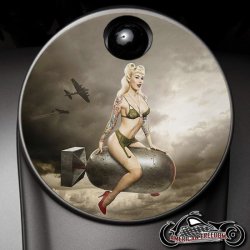
A stock engine cover does its job. It also looks like every other stock engine cover in the parking lot. So, can photos decorate engine covers without turning a hard-ridden motorcycle into a rolling craft project? Absolutely - when the image is applied with a process built for heat, weather, road grit, and the real life of a bike.
A meaningful photograph, your unit patch, a family logo, old-school pinup art, a flag, a skull, or a design nobody else is running can become part of the machine. The difference comes down to the part, the artwork, the fitment, and the finish holding it all together.
Can Photos Decorate Engine Covers and Last?
Yes, but a photo-worthy engine cover needs more than a sticker slapped over metal. Engine-side parts live in a rough neighborhood. They see heat cycles, vibration, rain, wash chemicals, fuel splashes, boot scuffs, and everything the road throws upward. A thin decal may look sharp on day one, then lift at an edge, fade in the sun, or collect grime around the border.
The right approach starts with a precision-machined cover made for the motorcycle, then applies full-coverage artwork through a high-heat hard-coat imaging process. The image becomes part of a durable finished surface rather than an afterthought sitting on top. That is how a high-resolution photo can carry real color, contrast, and detail while still belonging on a motorcycle that gets ridden.
It is not magic, and it is not a free pass to abuse any finished part. Harsh abrasives, careless tool use, and direct impact can damage nearly anything. But a properly finished decorative cover is made to hold its ground through normal riding, washing, and miles - not just look good under garage lights.
The Best Covers for Personal Photos
Not every motorcycle part offers the same canvas. A derby cover is one of the strongest choices because it sits in a visible spot on the primary and gives artwork a clean, defined frame. It is a small part with a loud visual payoff, especially on Harley-Davidson Big Twin, Twin Cam, Milwaukee-Eight, and 883/1200 Sportster platforms.
Timing covers and inspection covers also work well for focused artwork. Think a clean badge, a tight crop of a favorite photo, a military insignia, or a logo with enough contrast to read from a few feet away. Horn covers bring the image forward on the bike, while fuel doors and console covers can extend a theme beyond the engine area.
The biggest rule is fitment. A cover has to be more than the right general shape. Bolt pattern, diameter, engine family, and the location of features all matter. A photo of your kids or a hard-edged Reaper graphic means nothing if the part does not correctly fit your Harley, Indian, Victory, or Suzuki. Confirm the model-specific application before you get attached to a design.
Match the Image to the Shape
A round derby cover does not behave like a rectangular photo print. The best artwork is composed with the cover shape in mind. Faces, logos, lettering, and meaningful details should stay clear of mounting holes and avoid the outer edge where the visual field gets tight.
A full motorcycle photo can work, but it usually needs a strong focal point. Crop it around the rider, the front end, or the tank graphic rather than trying to cram an entire scenic shot into a small circle. Close-up portraits, bold emblems, flags, pet photos, service insignia, and graphic art tend to hit harder because they stay readable at speed and at a stoplight.
If words are part of the design, keep them short and heavy. Fine script and long quotes may look great on a phone screen but disappear once reduced to cover size. A name, a date, a call sign, or a simple statement has more punch than a paragraph.
What Makes a Photo Look Good on Metal?
Resolution matters, but it is not the only factor. A clear original image with good lighting will generally reproduce better than a screenshot, a heavily compressed social-media image, or a photo taken from across a room. Send the largest original file available whenever possible.
Contrast matters just as much. A dark motorcycle with a dark cover can make a black-and-gray image look mean as hell, but important details need separation. A face under a black helmet, for example, may need a lighter background or a tighter crop. On the other hand, a full-color sunset, an American flag, or a bright club logo can create a serious visual pop against blacked-out components.
Do not confuse bright with better. Some of the most aggressive covers use restrained color, weathered textures, monochrome portraits, or deep shadows. The right choice depends on the rest of your build. A bagger with chrome, paint, and polished accents can carry a loud image. A stripped-down Dyna or blacked-out Sportster may look tougher with a single hard focal point.
Personal Art Beats Cookie-Cutter Chrome
There is nothing wrong with a clean factory-style cover if factory-style is your thing. But most riders customizing their bikes are not trying to blend in with a row of dealership accessories. They want a part that says something before the engine even fires.
Photos make that possible in a way generic engraved parts cannot. You can run a memorial image for a brother who rode with you. You can put your company mark on a fleet bike, bring your hunting camp emblem to your touring rig, or turn a photo of your own motorcycle into artwork on its next build. You can also go completely fictional: Day of the Dead art, an eagle and flag, a dark angel, gunfighter imagery, or a skull that looks ready to pick a fight.
That personal connection is why custom covers land differently. They are functional parts, but they are also conversation starters. The right one sets your ride off without asking permission from anybody else's taste.
Practical Details Before You Order
Start with the motorcycle, not the artwork. Identify the year, make, model, and engine platform, then select the cover style that fits. If you ride a Harley, know whether the part is for a Big Twin, Twin Cam, Milwaukee-Eight, or Sportster application. Small fitment differences are not small once the cover is in your hand.
Next, decide whether the design needs to match existing paint, grips, wheels, and accents or deliberately break away from them. Matching creates a finished custom-build look. Contrast makes the cover the point of attack. Both work. The mistake is choosing a design in isolation and realizing later that it fights every other part on the bike.
Finally, be realistic about custom production. Made-to-order parts are built around your selected image, size, and finish, not pulled from a bin like a generic replacement piece. Take a few extra minutes to review the image, spelling, and fitment before approving the order. Custom work is personal, and that is exactly why details matter.
A Better Way to Put Your Story on the Bike
Custom Derby Cover brings photo-quality artwork to precision-made derby covers, timing covers, inspection covers, horn covers, fuel doors, and console covers - turning personal images and bold graphics into hard-working motorcycle accessories. The goal is not to make your bike look decorated. The goal is to make it look like yours.
Pick an image with a reason behind it, choose a cover built for your exact machine, and let the artwork earn its place beside the motor. Your engine covers do not have to be blank metal. They can carry the memory, message, attitude, or outright menace that makes riders look twice.