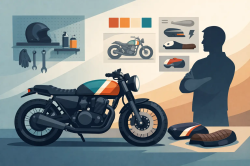
A stock motorcycle may run just fine, but it does not say much. Motorcycle customization is where a machine starts carrying your flag, your art, your attitude, and your story. Whether you ride a Milwaukee-Eight bagger, a Twin Cam cruiser, a Sportster, an Indian, a Victory, or a Suzuki, the goal is not to copy the next bike in the parking lot. The goal is to build a ride that gets recognized before the engine even fires.
That does not mean bolting on every shiny part you can find. The best customs have a point of view. A blacked-out street bruiser, a patriotic touring rig, a Day of the Dead build, a stripped-down bobber, or a bike built around your own military insignia all make sense when the details pull in the same direction. The strongest builds are personal without becoming cluttered.
Start Motorcycle Customization With a Clear Identity
Before you choose a cover, grip, seat, or paint color, decide what your bike is supposed to feel like. Not what is trending this month. Yours. Maybe it is old-school American iron with worn leather and raw metal. Maybe it is a dark, aggressive machine built around skull art, reapers, and deep gloss black. Maybe it is a clean show bike with color-matched accents and a family logo worked into the details.
This choice keeps you from wasting money on parts that fight one another. A chrome-heavy classic look can be killer, but it can lose its edge when mixed with tactical matte-black accessories and neon graphics. On the other hand, contrast can work when it is deliberate. A polished motor against a dark custom derby cover can put the focus exactly where it belongs.
Think of your motorcycle in layers. The foundation is the overall color and finish. The major visual pieces are the tank, fenders, wheels, exhaust, and seat. Then come the details that make riders walk closer: derby covers, timing covers, inspection covers, horn covers, fuel doors, and console covers. Those smaller components may not take up the most real estate, but they sit in high-visibility spots and can set the whole ride off.
The Details Make the Build
Engine and body covers are not filler parts. They are prime territory for showing personality without tearing your motorcycle apart for months. A custom cover can carry a flag, a skull, a pinup, a badge, a photograph, an original illustration, or a business logo. It is functional hardware with something to say.
This is especially true on Harley-Davidson platforms, where the primary cover area is impossible to ignore. A derby cover on a Big Twin, Twin Cam, Milwaukee-Eight, or 883/1200 Sportster sits right where people look when they walk around the bike. A generic replacement cover does the job. A full-coverage graphic part turns that same location into a focal point.
The trade-off is simple: loud art demands discipline everywhere else. If your cover carries a full-color We The People Flag graphic, let it have room to breathe. Pair it with finishes and accents that support the image instead of adding five other competing themes. If your entire build is already loud, a crisp black-and-metal design may be the better move. Custom does not always mean more. It means intentional.
Fitment Is Not the Boring Part
The fastest way to ruin a good customization plan is ordering a part because it looks right in a photo without confirming that it belongs on your motorcycle. Harley-Davidson has several engine families, model years, primary setups, and cover dimensions. Indian, Victory, and Suzuki models have their own fitment requirements. Close is not good enough when bolt patterns, clearances, and mounting points are involved.
Know your year, make, model, engine platform, and any changes made by a previous owner. If your bike has an aftermarket primary, a conversion kit, or parts swapped from another model year, take an extra minute before placing an order. That small bit of homework saves the headache of receiving a killer-looking piece that does not mount correctly.
Fitment also affects the visual result. The right cover should sit cleanly, align properly, and look like it was built for the bike because it was. Precision-machined parts give custom art a proper foundation. When the shape, finish, and hardware all work together, the final result feels like a real build, not a decal thrown at a problem.
Choose Finishes That Can Take a Ride
Motorcycles live outside. They take heat, vibration, road grit, fuel splatter, weather, boot scuffs, and whatever else the highway decides to throw at them. That is why the process behind a custom graphic matters as much as the graphic itself.
A cheap surface treatment can look great for a few weekends, then fade, peel, scratch, or turn cloudy. It might be fine for a garage-only project, but it is a weak choice for a bike that gets ridden. Look for a process designed for real motorcycle conditions, with artwork applied to a quality part and protected by a durable hard-coat finish.
Custom Derby Cover uses high-heat hard-coat imaging on precision-machined accessories, built to carry photo-quality artwork while standing up to the life of the motorcycle. That matters when your chosen image is more than decoration. A unit patch, a memorial photo, a personal logo, or art you created deserves better than a temporary finish.
There is still a practical balance. Mirror-polished parts can look incredible, but they demand more upkeep. Matte and black finishes hide some road grime better, though they can show scuffs differently. Full-color graphics bring maximum impact, while monochrome art can give a bike a meaner, more restrained look. Choose the finish that matches how you actually ride, park, clean, and live with the bike.
Make It Personal Without Making It Complicated
The best part of custom motorcycle work is that the source material can be yours. You do not have to settle for another catalog skull if your own artwork, family photo, club design, shop logo, or service emblem has more meaning. A personal image can turn a cover into the piece that defines the entire build.
Use a high-resolution image whenever possible. Sharp original art, clean logo files, and well-lit photos give the finished part the best chance to hit hard. A tiny screenshot pulled from social media may work as inspiration, but it may not have enough detail for the kind of crisp, full-coverage result you want. If an image matters, start with the best version you can get.
Also consider where the art will land. A circular derby cover is not a billboard. Strong central subjects, bold contrast, readable lettering, and artwork with a clear focal point generally perform better than a crowded design packed with tiny details. If you want text, keep it short and make sure it is large enough to read from a few feet away.
Build Over Time, Not Out of Panic
You do not need to finish a motorcycle in one weekend. In fact, rushing a build is how people end up with expensive parts they later replace. Start with the areas that give you the biggest visual return: the covers, seat, bars, lighting, wheels, or exhaust, depending on your starting point. Then let the next decision grow naturally from the last one.
Take pictures as the build changes. What feels perfect in the garage can look different in daylight, at a gas stop, or next to other bikes. Photos reveal clashing finishes, uneven color balance, and details that deserve more attention. They also help you see when the bike is done. Yes, a custom motorcycle can be done for now, even if riders never stop thinking about the next change.
Your bike does not need permission to be personal. Pick the artwork that means something, confirm the fitment, choose materials made to last, and make every visible part earn its place. When you pull up and someone says, “That bike is you,” you built it right.