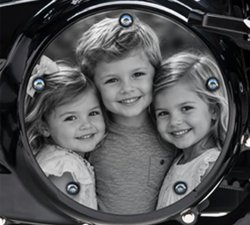
That worn-out stock derby cover is prime real estate. It sits right where people look when they walk up to your bike, yet most riders leave it blank, black, or buried under the same tired chrome everybody else runs. A personal photo cover transformation turns that small piece of metal into a statement with some real weight behind it - your family, your unit, your dog, your old man, your business, your flag, or the photo that takes you right back to a ride you will never forget.
This is not a sticker slapped over a part. Done right, a personal image becomes full-coverage artwork on a precision-made motorcycle cover built for your specific ride. The result should look like it belongs on the bike, hold up under heat and miles, and make generic parts look exactly like what they are: generic.
What a Personal Photo Cover Transformation Can Be
A custom photo cover does not have to be a straight portrait copied onto a round piece of metal. In fact, the strongest designs usually start with a photo but become something more deliberate. A black-and-white shot from a cross-country run can become gritty, high contrast artwork. A clean family photo can be framed with a flag, flames, wings, or a name. A hunting picture, military image, club mark, memorial portrait, shop logo, or an original sketch can all carry a bike's personality without looking like an afterthought.
The part you choose changes the effect. A derby cover gives you a prominent canvas on many Harley-Davidson Big Twin, Twin Cam, Milwaukee-Eight, and Sportster models. Timing covers and inspection covers let you build a coordinated look around the engine. Horn covers, fuel doors, and console covers can carry the same image, a matching symbol, or a detail pulled from the main design.
There is a trade-off here. One standout derby cover can be mean, clean, and focused. Matching several covers creates a full custom package, but it takes a more disciplined visual plan. If every part has a different photo fighting for attention, the bike can look busy fast.
Start With the Story, Not the File
The best custom parts have a reason to exist. Before choosing an image, ask what you want somebody to understand when they see the bike at a gas stop or bike night. That answer guides every design call afterward.
A memorial cover may call for a single strong portrait, a date, and a subtle background rather than a pile of graphics. A company bike may need a logo that stays readable at a glance. A patriotic build can carry a weathered flag, eagle, military insignia, or a photo from service. A personal ride built for attitude might be better served by a hard stare, a skull-inspired treatment, smoke, or a darker color palette.
Pick one main subject. A derby cover is not a billboard, even when the artwork is packed with detail. Faces, motorcycles, logos, and meaningful symbols all need room to breathe. If the point of the part is a photo of your daughter on your bike, make that the hero. Do not shrink her face into a corner to make room for six slogans and a dozen clip-art flames.
Choose a Photo That Can Take the Heat
A powerful image on your phone can still be the wrong image for print. The problem is usually resolution, lighting, or composition. Screens are forgiving. A hard-coated motorcycle part puts every soft edge, heavy shadow, and blurry face under a much brighter spotlight.
Resolution matters more than file size
Use the original photo whenever possible, not a screenshot, social media download, or image sent through repeated text messages. Those copies are often compressed and can leave the finished artwork looking muddy. A sharp, well-lit photo taken with a current phone or camera is often plenty good, provided it is the original file.
Close-up subjects usually reproduce better than distant ones. If the person, pet, bike, or object occupies only a tiny patch of the photo, enlarging it to fill a cover can expose softness. That does not always kill the idea. A skilled design treatment can turn a softer image into a vintage, distressed, monochrome, or illustrated look. Just do not expect a blurry wide shot to suddenly become crystal clear.
Think about the shape of the part
Round covers crop differently than a rectangular photograph. The corners of your image may disappear, and the center often carries the visual punch. Keep faces, logos, and critical details away from the outer edge. If a loved one's face sits near one side of the original photo, a designer may need to reposition it or build out the background so the artwork fits the cover without cutting off what matters.
Color needs the same thought. Deep blacks, rich reds, weathered steel tones, and high-contrast graphics can look vicious on a dark build. Bright photos can be incredible too, especially on a show bike, but overly pale backgrounds may not create the hard-hitting definition riders expect. It depends on the bike's paint, chrome, powder coat, and the finish you want across the rest of the build.
Use artwork you have the right to use
Personal photos, your own artwork, business logos you control, and designs you commissioned are solid ground. Be careful with professional photographs, copyrighted artwork, and logos you do not own. A custom cover should celebrate your story, not create a headache over somebody else's work.
Build the Design Around the Bike
A cover can be personal without being random. Look at the motorcycle as a whole before you settle on colors and graphics. A blacked-out Street Glide, a red Road King, a white Sportster, and a polished-chrome Softail do not all need the same visual treatment.
If your bike already carries loud paint or airbrushed bodywork, a restrained cover may hit harder. Pull one color from the tank, use a clean border, and let the photo do the talking. On a mostly black motorcycle, the cover can become the knockout punch: vivid color, a bold flag, or detailed photo art that draws eyes straight to the engine.
Finish plays a role, too. A polished look brings brightness and contrast against black components. A black finish can make the artwork feel darker, tougher, and more integrated with a murdered-out build. Neither is automatically better. The right choice is the one that supports the personality of the bike instead of competing with it.
Why the Process Matters on a Motorcycle Part
Your engine area is not a bedroom wall. It sees vibration, heat, road grit, cleaning products, rain, and constant attention from riders who know the difference between real parts and cheap decoration. That is why the production method matters as much as the image.
A quality photo cover starts with the correct, precision-machined part for the motorcycle platform. Fitment is not a minor detail. A cover made for one Harley application may not fit another, even when the bikes look close at a glance. Confirm your year, model, engine platform, and cover position before ordering. Big Twin, Twin Cam, Milwaukee-Eight, and 883/1200 Sportster setups have defined requirements, and Indian, Victory, and Suzuki riders need the same vehicle-specific care.
Then comes the finish. High-heat hard-coat imaging is built to put full-coverage, photo-quality artwork onto the part itself, creating a durable surface meant to hold its color and detail for the life of the motorcycle. That is a different animal from a temporary decal with exposed edges waiting to lift.
At Custom Derby Cover, each piece is made to order in the USA around the selected design, size, finish, and fitment. That gives riders real freedom, but it also means you should treat the approval stage seriously. Double-check spelling, dates, logo versions, and the photo you submit. Personal custom work is usually final sale because it was built for your bike and nobody else's.
Make It Personal Without Making It Complicated
The strongest photo cover designs are clear from a few feet away and rewarding up close. Keep the main image strong, use text sparingly, and choose details that mean something. A name, rank, road name, date, or short phrase can add punch. A paragraph of text will usually disappear into the artwork.
If you are unsure where to start, send the best original photo you have and explain the feeling you want: patriotic, memorial, outlaw, clean and classic, dark and aggressive, or loud enough to stop traffic. That direction is often more useful than trying to force a full design before the image has been sized for the part.
Your bike already carries the miles, the scars, and the stories. Put one of those stories on a cover that can take the same road punishment the rest of your machine does.